Hello, I am Dongju Hyun, M.D., the Medical Director and a Board-Certified Dermatologist at TERRA Dermatology Clinic.
When people hear “Botox,” wrinkles are usually the first thing that comes to mind. Yet the same drug slims a square jaw, stops underarm sweating, shrinks pores, and is even used on surgical scars.
How can one drug do all of that? Because it all comes down to a single mechanism. Understand that one idea today, and your next Botox consultation will make far more sense.
Botox Interrupts a Command, Not a Muscle
Our nerves deliver commands using a chemical called acetylcholine. It sits packaged in tiny pouches at the nerve ending, and when a command arrives, the pouches burst and the signal is passed along.
Botox keeps those pouches from bursting. With no command getting through, the target tissue takes a rest — and once the nerve grows new connections, about three to four months later, everything returns to normal. That is why the effect is never permanent.
And here is the key point: muscles are not the only tissue that takes orders from acetylcholine. Sweat glands and salivary glands work the same way. That is why Botox has such a wide range of uses.
Wrinkle Botox — Closer to Prevention Than Correction
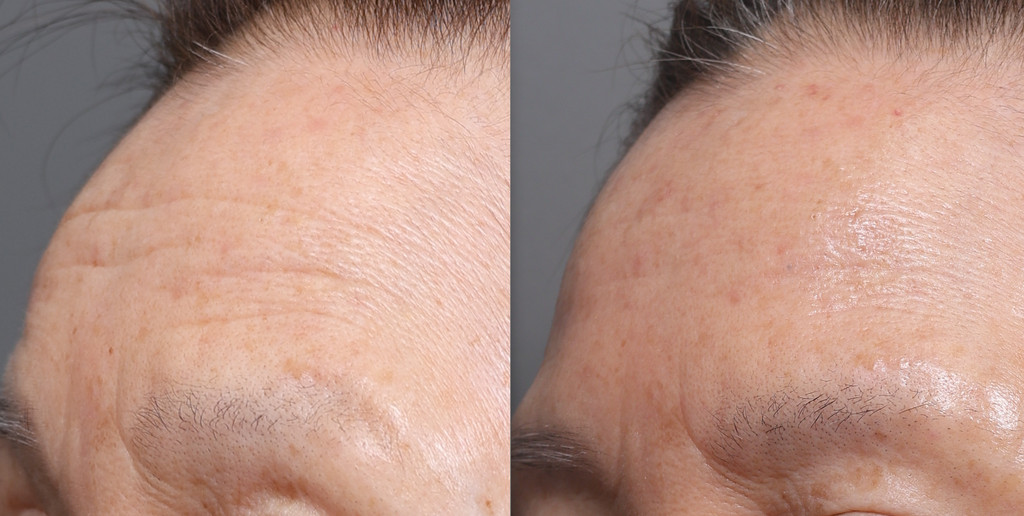
The forehead, between the brows, the outer corners of the eyes. These are all places the face folds when you make an expression. Fold thousands of times a day and a crease sets in, much like paper.
Wrinkles pass through two stages: dynamic wrinkles, visible only when you make an expression, and static wrinkles, which remain even at rest. Botox works best on the first stage. By reducing how often the skin folds, it slows the shift into deep, fixed lines.
The order is fairly predictable. The skin around the eyes is thinnest and never stops moving, so it begins in the late twenties, followed by the forehead and then the area between the brows.
So you do not have to wait until wrinkles appear. You can begin preventively in your late twenties, when fine lines first show around the eyes. Even a small dose that eases the folding habit makes a difference.
On the other hand, if you find yourself thinking “there is a line between my brows even when my face is relaxed” in your forties, the window for prevention has already passed. At that point Botox alone will not smooth it out completely, and resurfacing or filler is considered alongside it. Catching a wrinkle before it deepens is far easier than erasing one that has already set.
Muscle Botox — Reducing Size, Not Movement
A muscle that goes unused atrophies and becomes thinner. Muscle Botox uses that principle to reduce the bulk of an overdeveloped muscle. If wrinkle Botox addresses a muscle’s movement, this addresses its thickness.
- Masseter (square jaw) — when the chewing muscle is overdeveloped and widens the lower face
- Temporalis (head shape) — when the temples bulge and the head looks angular
- Trapezius — refining the shoulder line and easing tightness
- Calves — for a well-developed gastrocnemius
One thing to keep in mind is timing. Wrinkle Botox shows within days, but muscle Botox needs time for the muscle to thin, so it appears gradually over four to six weeks. Many patients tell me “it has been a week and nothing has changed” — that is a normal course. In exchange it lasts longer, around four to six months.
Salivary Gland Botox — It Shrinks Even Though It Is Not a Muscle
If you have had masseter Botox and the area just below the ear is still full, the cause may not be muscle but a salivary gland. Salivary gland Botox mainly targets the parotid gland, which sits just behind the masseter, right under the ear.
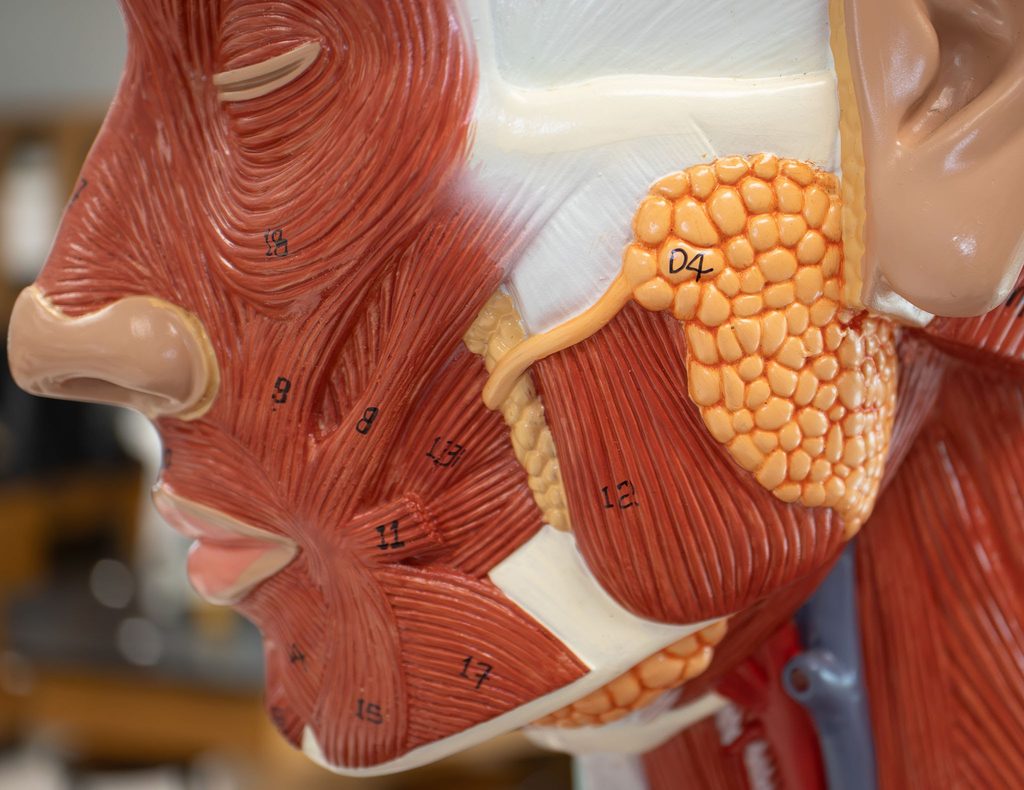
There is a simple way to check. Look in the mirror and trace your jawline. If the angle where it turns from below the ear toward the chin is not clearly defined and instead runs blunt and rounded, an enlarged parotid gland is likely.
A salivary gland is not a muscle, but the command to “make saliva” also arrives as acetylcholine. So Botox reduces that stimulation, the gland gradually becomes smaller, and the jawline that had been hidden begins to show. The same mechanism, applied somewhere new.
Dermatoxin — Botox Placed Shallowly in the Skin
Diluted Botox is placed shallowly and densely into the dermis. The muscle is not engaged at depth; only the signals within the skin are affected. That means several concerns can be addressed at once while your expressions stay intact.
- Sebum and pores — less sebum, smaller pores, smoother texture. A good fit for the nose and T-zone.
- Sweat — sweat gland signals are reduced as well. Patients with a sweaty face notice this the most.
- Fine lines — surface crepiness softens.
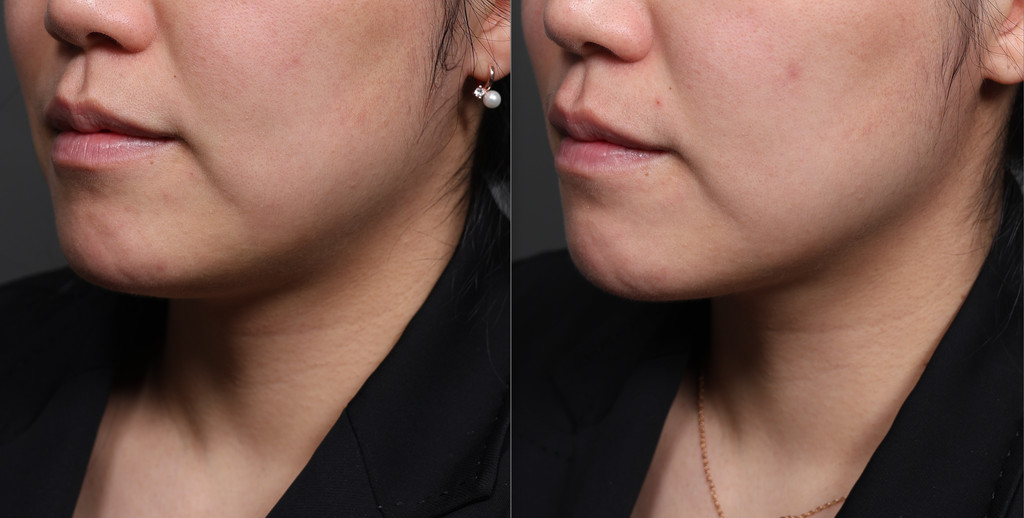
- Jawline — easing the downward pull of the platysma tidies the jawline.
- Facial contour — placed along the hairline, the contour looks noticeably smoother.
The effect lasts around three months.
For reference, hyperhidrosis has the strongest evidence of all. Underarm hyperhidrosis is an FDA-approved indication in the United States, and the palms, soles and scalp respond as well.
Other Uses
Scars — one reason surgical scars widen is the pull of the surrounding muscle. Letting that muscle rest right after closure helps the scar heal finely. Timing matters: it works best as early prevention, not on an old scar.
Hair loss — this is being studied on the hypothesis that scalp blood flow improves, but it is still at an early stage. It can be used as an adjunct to other treatments.
Does Resistance Really Develop?
It can, but it is uncommon. At cosmetic doses (under 100 units for the whole face), the chance of developing neutralizing antibodies is less than 1%. Antibody problems have mostly been reported in therapeutic settings using several hundred units.
What raises the risk is a full dose repeated at short intervals. Touching up one or two spots is not a real concern, but repeating a complete dose within two or three weeks is the riskiest pattern. International guidance is a minimum interval of 12 weeks.
“Can I just switch brands?” is a question I hear often. Once antibodies have formed, switching does not help — the part the antibody binds to is the same core in every brand. As prevention, though, it does matter. Products differ in how much accessory protein surrounds that core, and this protein can nudge the immune response along. If you plan to repeat high-dose treatments such as masseter or calf Botox over a long period, it is worth factoring this into your product choice.
One last thing. Not every drop in effect is resistance. Injection placement, dose, or a muscle that has redeveloped are far more common explanations. Rather than switching brands first, talk it through with the clinic that treated you.
💡 Frequently Asked Questions (FAQ)
Q. If I stop getting Botox, will my wrinkles get worse?
A. No. They simply return to where they were. That said, the progression that had been slowed resumes, so it can feel as though they have worsened.
Q. Will masseter Botox make my cheeks sag?
A. As the muscle shrinks, the skin that had wrapped around it can feel looser. It usually recovers, but if elasticity is already significantly reduced, we consider adjusting the dose or combining a skin-tightening treatment.
Q. How long does it last?
A. Wrinkles, three to four months; masseter, four to six months; dermatoxin, around three months. It varies from person to person.
Q. Is there anything to watch for afterward?
A. Do not lie down for a few hours, and do not rub or massage the treated area. It is also best to avoid alcohol and saunas that day.
Botox is the most basic of aesthetic procedures, yet where, how much and how it is placed changes the result entirely — which is exactly what makes it a difficult one.
If you would like to know the best solution for your own skin and muscle, you are always welcome to visit us.
Thank you for reading. This has been Dongju Hyun, M.D., Medical Director of TERRA Dermatology Clinic, Gangnam.