Hello, I am Dongju Hyun, M.D., the Medical Director and a Board-Certified Dermatologist at TERRA Dermatology Clinic.
“Apply a generous amount — about two fingertip lengths.” “Put it on 20 minutes before you go out.” “Reapply every two to three hours.” You have probably heard all of this about sunscreen. But keeping every rule through a busy day is not easy, and you may have honestly wondered, “Do I really need to go this far?”
So today I am not going to explain this with words alone. I applied sunscreen to my own face and photographed it with a UV camera, verifying each claim with results you can actually see. At the end, I will also walk through how to choose a good sunscreen — which makes all of this far easier to keep up.
※ On a UV camera, the better the UV is blocked, the darker the skin appears. Areas where coverage is missing show up bright. With the UV camera software used here, protected areas appear dark reddish.
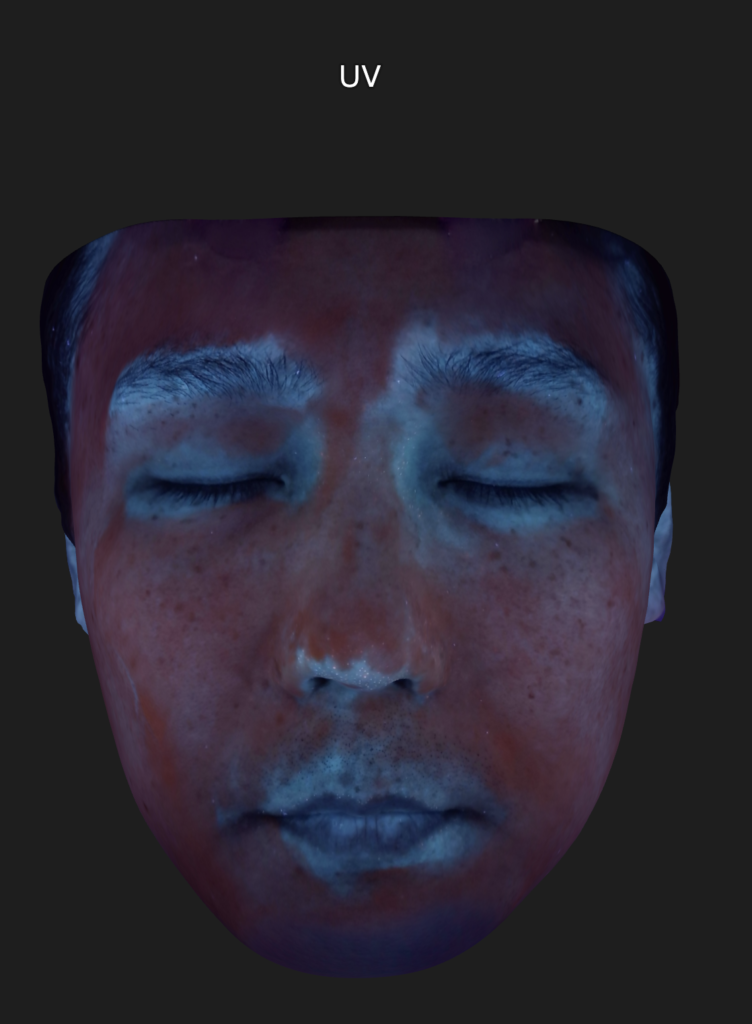
1. Why “Two Fingertips”? The Right Amount, by the Numbers
The most common mistake is the amount. And the two-fingertip rule is not a rough feeling — it is a number that comes from a calculation.
The SPF and PA values printed on a sunscreen are measured with 2 mg applied per 1 cm² of skin. The average Korean adult face is about 400–450 cm².
- 400–450 cm² × 2 mg = about 800–900 mg (0.8–0.9 g) → for the face alone
- Including the neck, you need more than 1 g
Since you cannot weigh this out every morning, it was converted into finger lengths — the FTU (Finger Tip Unit).
① The FTU and the “Two Fingertip Rule”
- 1 FTU = the amount squeezed from the tip of the index finger to the first crease ≈ about 0.4–0.5 g, enough to cover the area of two adult palms
- The face = about 2 FTU → hence the familiar guideline of a strip twice the length of your fingertip segment
In other words, “two fingertips” is simply the easiest way to hit the 0.8–0.9 g calculated above.
② Experiment: Full Amount vs. Half Amount
The photo on the left shows the recommended amount (one fingertip unit); the one on the right shows only half that amount. Both were taken with a UV camera.
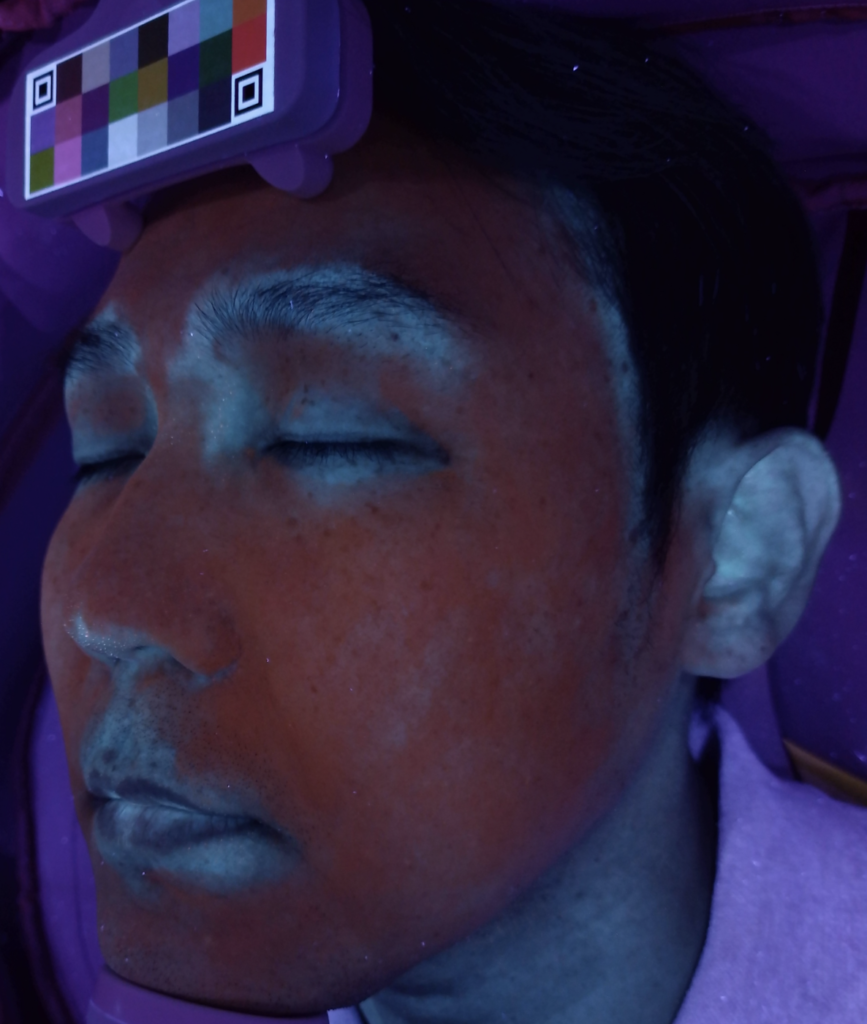

The result is clear. On the right, where less was applied, the coverage looks patchy, with bright gaps in places. Halving the amount does not halve the protection — it drops to well below half of the labeled value.
2. Do You Really Have to Wait 20 Minutes? — Film Formation and “Leveling”
The short answer is yes, and there is a reason for it.
Right after application, the UV filters sit on the skin in an uneven layer. Over time the volatile components evaporate, the film spreads out evenly, and a stable protective layer forms. This process is called leveling, and it usually takes 15–20 minutes.
If the skin meets strong sunlight, sweat, or friction before that film has settled, the protective layer can be disrupted before it has even finished forming.
Experiment: Immediately After vs. 20 Minutes Later
I photographed the same area “immediately after applying” and “20 minutes later” at an identical angle and under identical lighting.
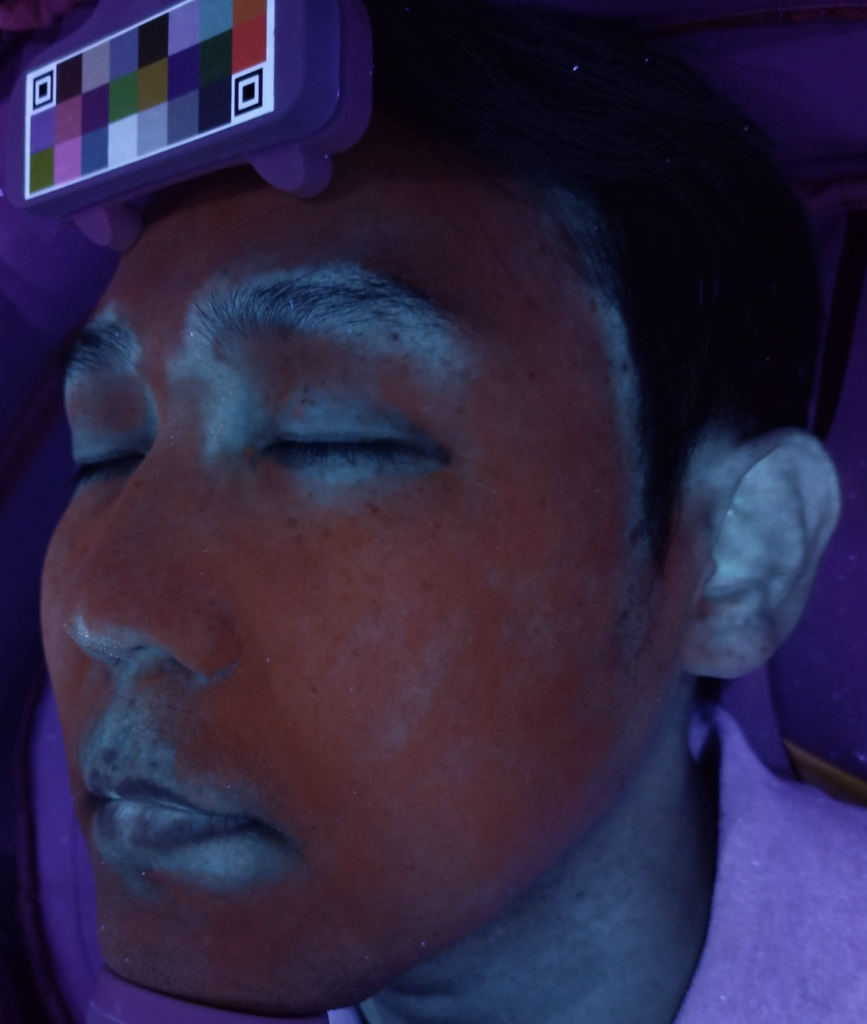
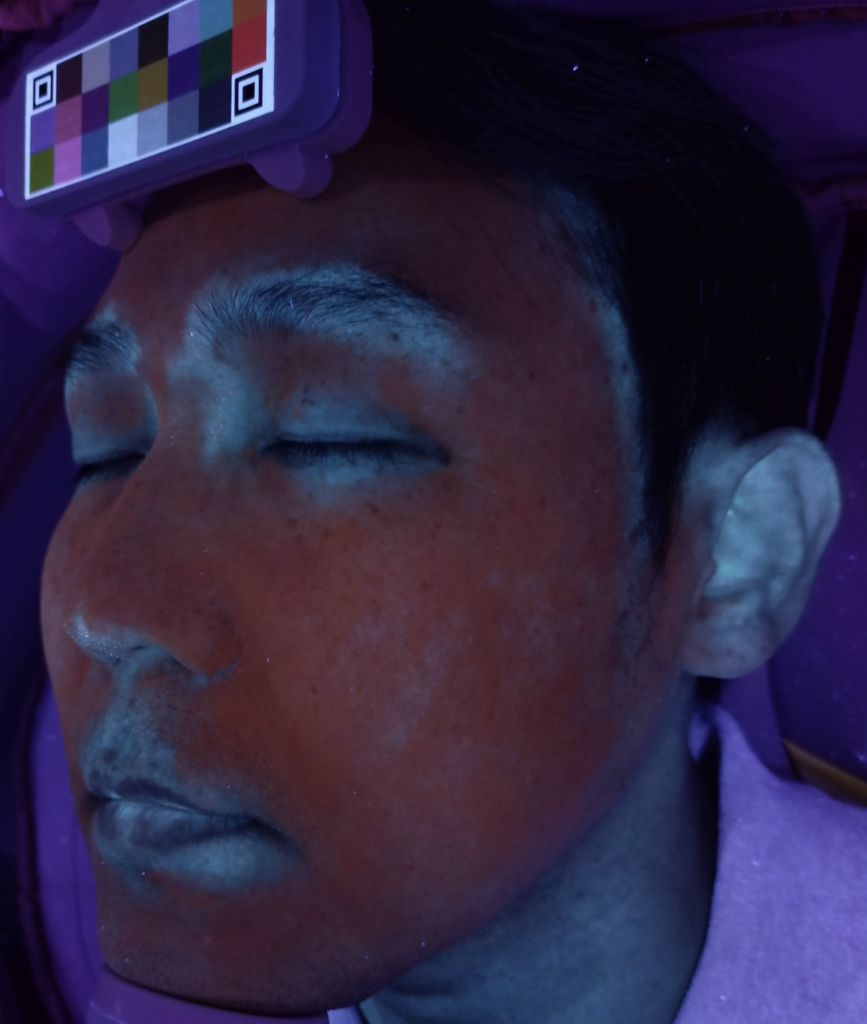
The difference looks subtle to the eye, but after 20 minutes the skin appears more even and darker.
Before the film sets, even very light friction can wipe it away, so some care is needed. In fact, I rubbed my cheek only very lightly after applying, and the UV photo taken 20 minutes later shows how easily the sunscreen on that cheek came off.

Immediately after applying sunscreen
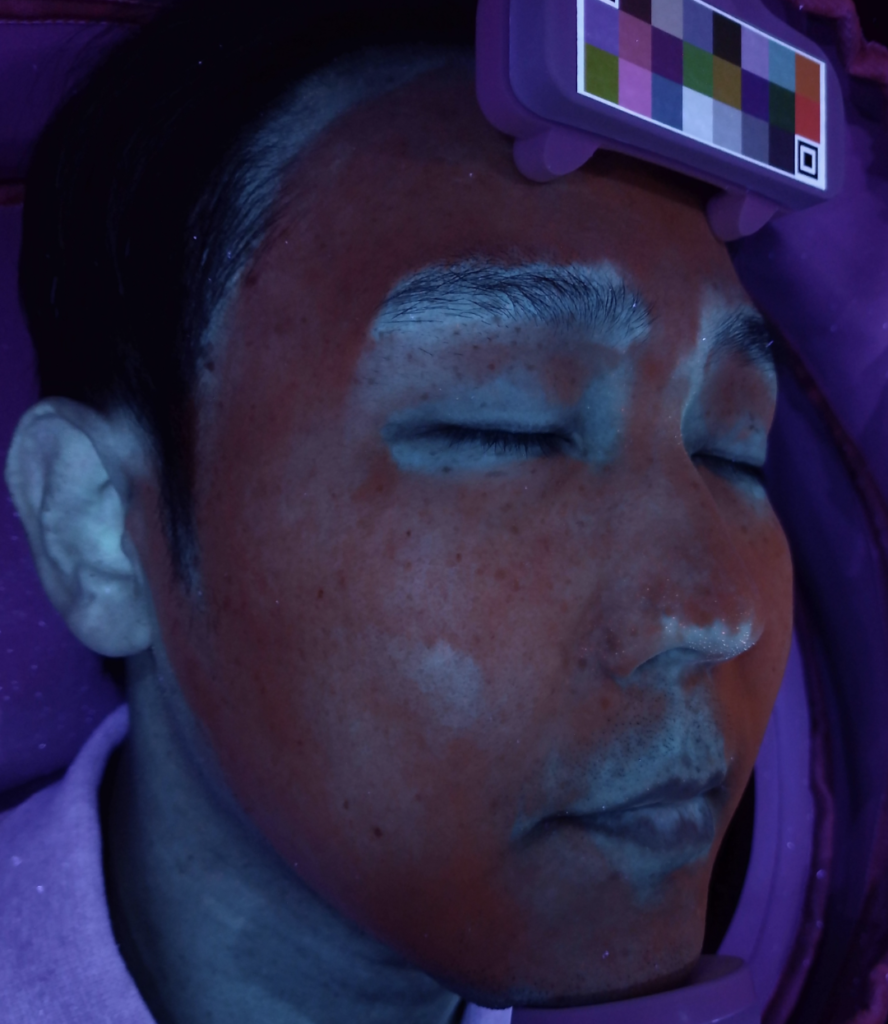
20 minutes after applying — the area on the right cheek where the sunscreen was wiped away
3. Is Reapplying Really Necessary? — I Photographed It Disappearing
Reapplying is the most tedious step of all. And sunscreen does not simply disappear “because time has passed.”
- Expression and movement: talking, smiling, opening your mouth
- Friction: masks, hands, and hair touching the skin
- Sebum and sweat: oil and sweat rising from the pores push the sunscreen away starting around the pores
① Experiment: The Face After 4 Hours
I applied the full amount in the morning, went about my day as usual, and photographed with the UV camera four hours later.
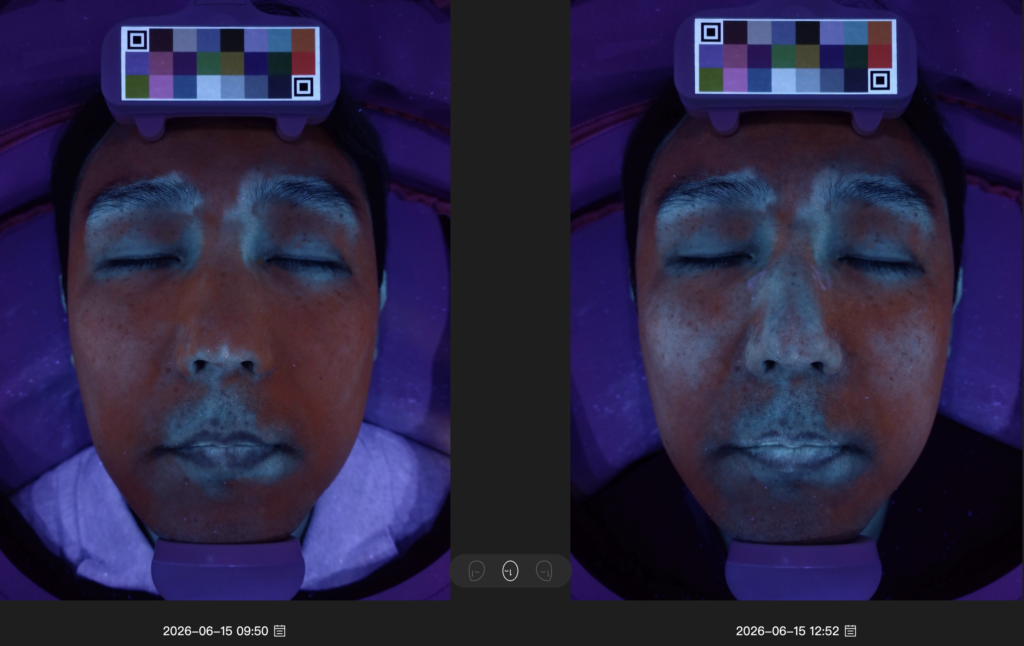
The film starts breaking up first on the nose and forehead, where sebum output is highest. I also wore a mask on and off, so you can see the protection stripped away far more severely where the mask made contact.
② How to Reapply — Use a Cushion
You do not need to start over with a thick layer. A cushion-type sunscreen patted on lightly, or a stick type swiped over the skin, is enough to top the film back up. Focus on the areas the photos show wearing off first.
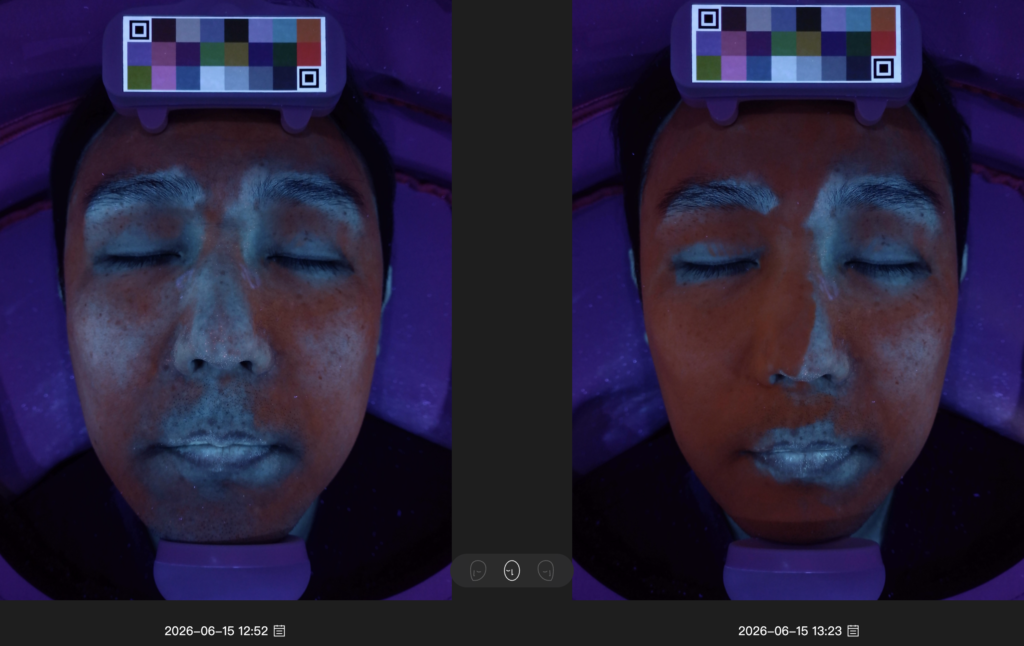
Photographed right after reapplying, the coverage is even again, unlike the four-hour photo. (Only the right side of the face was reapplied, for the 8-hour comparison.)
③ The Key Experiment: Reapplying on One Side Only, Compared 10 Hours Later
This is today’s highlight. I reapplied on only one side of the face partway through the day, left the other side alone, and photographed both sides at the 10-hour mark.
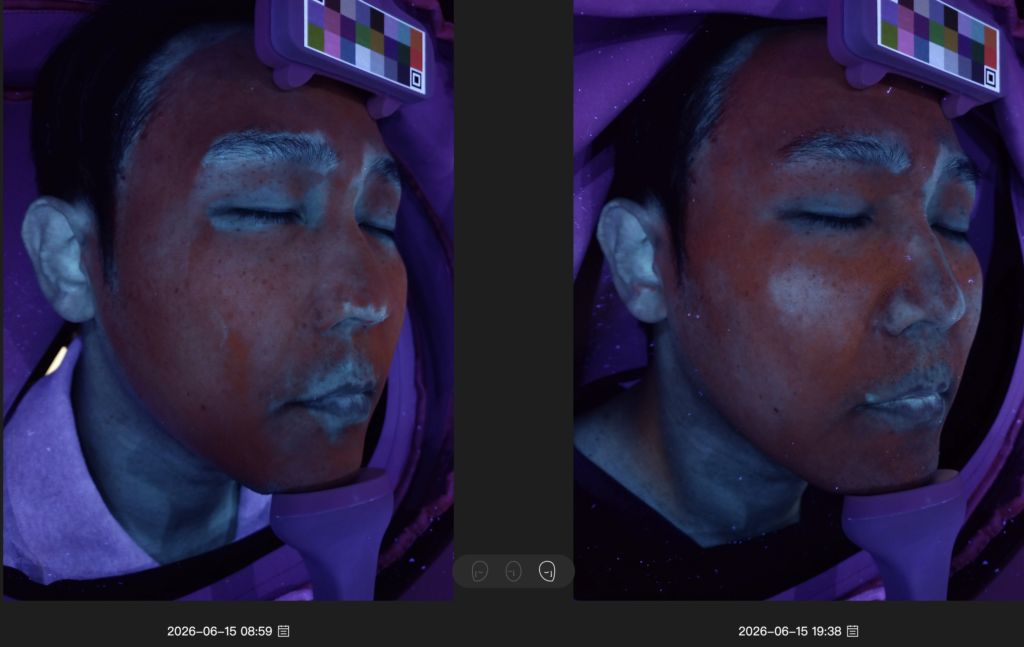
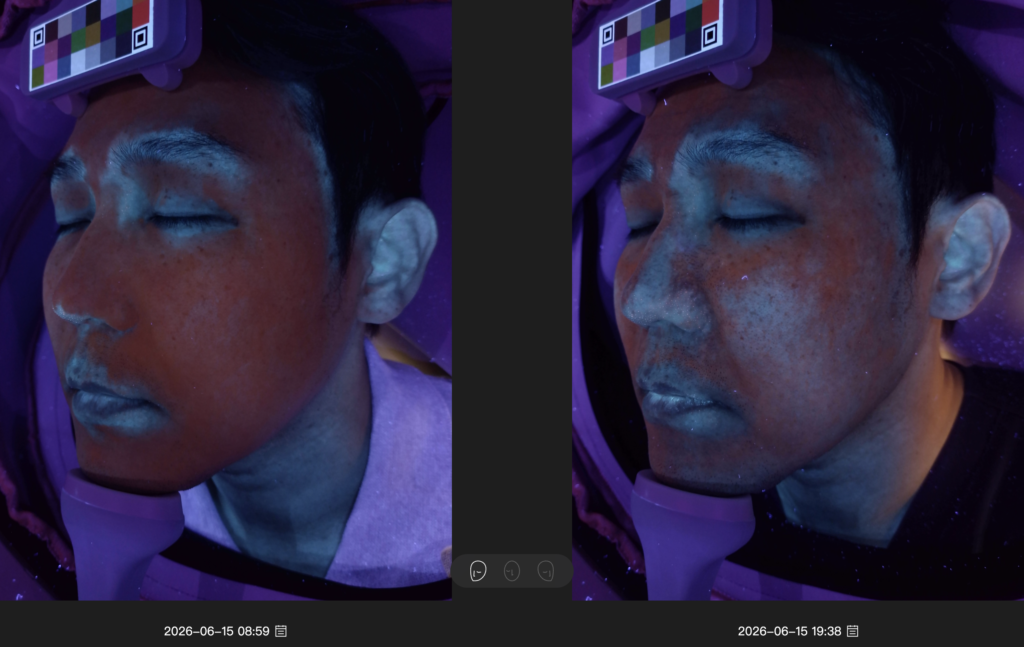
The difference is unmistakable. The reapplied right side still has meaningful protection, while the untouched left side is essentially unprotected. Reapplying is not optional — it is what carries the protection through the day.
4. So How Do You Choose a Good Sunscreen?
If you want these hard-to-keep rules to be a little easier, product choice matters. Just remember five things.
① Mineral vs. Chemical — the Right Answer Is “Your Own Skin”
| Category | Mineral (inorganic) | Chemical (organic) |
|---|---|---|
| How it works | Reflects and scatters UV | Absorbs UV and converts it to heat |
| Strengths | Low irritation, generally fine for sensitive skin | Light feel, minimal white cast |
| Drawbacks | Heavier, prone to white cast | Some filters can cause dermatitis or sting the eyes |
| Best for | Sensitive or breakout-prone skin | Oily skin, or anyone who dislikes white cast |

The table above is a general summary — treat it as a reference only. Many products today use hybrid formulas, and many mineral sunscreens now use finely milled particles to reduce white cast. And even though mineral filters are gentler, a product containing comedogenic ingredients such as ethylhexyl palmitate, isopropyl-based ingredients, or stearic acid can still trigger breakouts. There is no single right answer — the one that suits your own skin is the best sunscreen.
To summarize:
- Healthy skin that wants no white cast and a light feel: choose a serum-type chemical sunscreen.
- Sensitive skin with a compromised barrier: choose an easy-wash mineral sunscreen.
- Skin that frequently develops inflammatory acne and breakouts: use a zinc oxide mineral sunscreen, but always check that it is free of comedogenic ingredients.
- Non-inflammatory acne (closed comedones and heavy sebum only): a lotion-type chemical sunscreen also works well. Check that it is free of comedogenic ingredients.
② Good Filters vs. Filters to Avoid
For mineral sunscreens, either zinc oxide or titanium dioxide is fine. If you have to pick one, zinc oxide is preferable for its anti-inflammatory action.
For chemical sunscreens, it is best to avoid the older filters that were once widely used — avobenzone, octocrylene, octinoxate (ethylhexyl methoxycinnamate), and oxybenzone (benzophenone-3). Their photo-half-life is short, so they need reapplying every one to two hours; their small molecular size lets them penetrate the skin barrier easily, making them frequent causes of dermatitis and the main culprits behind stinging eyes. They are also a leading cause of coral bleaching and are increasingly being phased out. They still turn up often in inexpensive sunscreens, so it is worth checking the label.
The newer generation of chemical filters — Tinosorb M, Tinosorb S, Uvinul A Plus, Uvinul T 150 — have larger molecules, so they are far less likely to cause dermatitis, and they are reef-safe, showing no toxicity to coral. They also barely degrade in sunlight, so they have virtually no photo-half-life and stay effective for a long time. Because they work at lower concentrations, they are easy to formulate as oil-in-water products, which makes the texture excellent. That makes it easy to top up just the areas that have worn off.
③ Texture — Read the Front of the Ingredient List
Ingredients are listed in order of concentration. If the front of the list includes silicones such as dimethicone or cyclopentasiloxane, or quick-evaporating isododecane, the product will feel light going on. Do note that alcohol (denatured alcohol) can be irritating for dry or sensitive skin, so check for it. I recommend testing it on your own skin in store!
④ What Makes It Last — Film Formers and Photostability
- Film formers: ingredients ending in “-copolymer” or listed as “acrylates” hold the film evenly and improve staying power.
- Photostability: avobenzone (butyl methoxydibenzoylmethane), a UVA filter, degrades easily in sunlight, so products that pair it with a stabilizer such as octocrylene are more stable.
⑤ A Sunscreen That Washes Off Easily Is Not a Weak Sunscreen
Protection is determined by SPF/PA and the filters used; how easily it washes off is a separate property called water resistance. So:
- Everyday use (mostly indoors): a light formula that washes off easily, plus frequent reapplication
- Swimming or heavy-sweat days: a product labeled “water resistant” or “very water resistant”
Splitting them up this way makes sense. Even a product that washes off easily can be trusted for protection as long as the SPF/PA values and the MFDS functional cosmetic designation are on the label.
⑥ The Packaging Matters More Than You Would Think
UV filters can slowly degrade with repeated exposure to air and light. So rather than a wide-mouth jar, an airless pump or dropper format, which limits contact with air, is better for ingredient stability.
5. Conclusion: These Rules Are Repeated for a Reason
As the UV camera showed today, applying enough, waiting 20 minutes, and reapplying are not nagging — they are what determines whether sunscreen works. Add a formula suited to your skin and good packaging, and the same effort buys you meaningfully better protection.
Sunscreen is the cheapest and most effective anti-aging measure and skin cancer prevention available. I encourage you to give it a little more attention starting today.
💡 Frequently Asked Questions (FAQ)
Q. Do I need it on cloudy days or indoors?
A. Yes. A good deal of UVA passes through cloud, and ordinary window glass does not block UVA either. If you sit by a window or drive often, exposure accumulates indoors as well.
Q. If the SPF is high, can I skip reapplying?
A. No. Even a high SPF loses effect over time. A high number buys you a little margin — it does not replace applying enough and reapplying.
Q. Are chemical sunscreens worse for the skin?
A. Both mineral and chemical filters are effective and safe when used correctly. What matters is not the category but choosing a formula you can happily apply in sufficient amount every day.
Q. How should I remove sunscreen?
A. For waterproof, mineral, or heavily film-forming products, dissolve with a cleansing oil or cleansing milk, then follow with a mildly acidic foam cleanser (double cleansing). For light everyday formulas, a mildly acidic foam alone is usually enough. Avoid excessive rubbing, and replenish the barrier with moisturizer right after washing.
This article is based on the clinical experience of TERRA Dermatology Clinic and reliable published sources. If you would like to know the best solution for your own skin, you are always welcome to visit us.
Thank you for reading. This has been Dongju Hyun, M.D.