Hello. I am Dongju Hyun, M.D., the Medical Director and a Board-Certified Dermatologist at TERRA Dermatology Clinic in Gangnam.
Even after acne subsides, many individuals struggle with the lingering aftermath: red spots, brown discoloration, and uneven skin texture.
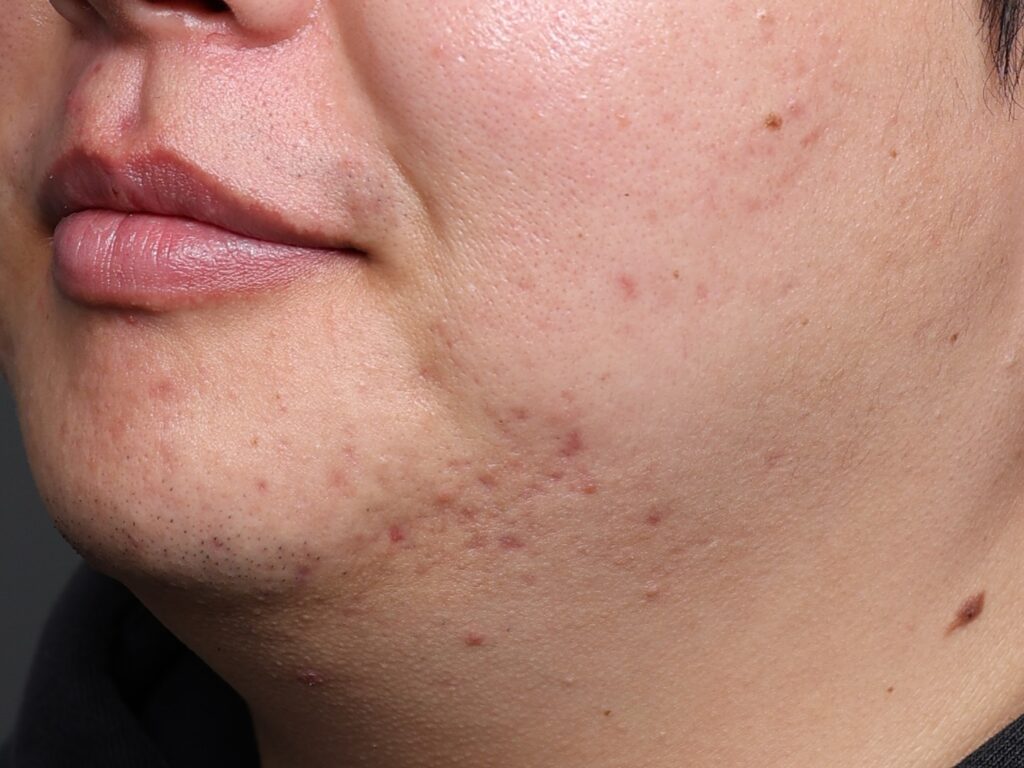
The primary issue is that people often group all of these distinct skin conditions under the single label of “acne scars.” Attempting to treat them with a one-size-fits-all approach usually leads to disappointing results. In reality, acne marks and depressed scars differ fundamentally in their depth, healing potential, and treatment methodologies.
Today, we will break down these post-acne traces into three clear categories: Red Marks, Pigmentation, and Depressed Scars.
1. Red Marks: Post-Inflammatory Erythema (PIE)
The pink or red marks left behind immediately after an acne lesion subsides are clinically termed Post-Inflammatory Erythema (PIE).
- The Cause: This condition is caused by temporary capillary expansion and damage, making the blood flow underneath look visible through the skin surface.
- Characteristics: The skin surface feels relatively smooth to the touch with minimal depression.
- Prognosis: While PIE can naturally fade over a period of 3 to 6 months, continuous irritation or unresolved inflammation can cause it to persist much longer. It is best understood as a temporary vascular change rather than a permanent, fully formed scar.
2. Pigmentation: Post-Inflammatory Hyperpigmentation (PIH)
When red marks gradually transition into brown, grayish-brown, or dark spots over time, the condition is classified as Post-Inflammatory Hyperpigmentation (PIH).
- The Cause: Triggered by acne-induced inflammation that overstimulates melanin production. While it may resemble sunspots or melasma, its root cause is the initial acne lesion.
- Characteristics: Like PIE, the skin surface remains flat and even, distinct from true structural scars.
- Prognosis: PIH can become significantly darker and more persistent if exposed to ultraviolet (UV) rays. Clinical studies show that PIH is incredibly common in acne patients and can persist for over a year, making rigorous UV protection and gentle skincare essential.
3. Depressed Scars: True Acne Scars (Atrophic Scars)
Unlike temporary marks, depressed acne scars represent a permanent alteration of the skin’s structural integrity.
- The Cause: Severe, deep-seated inflammation ravages the dermal layer, leading to the irreversible destruction of collagen and elastic fibers.
- Characteristics: When the tissue fails to regenerate adequately during the healing process, it leaves behind sunken, uneven, or atrophic scars. These become heavily pronounced under directional or overhead lighting due to shadowing.
- Prognosis: Research confirms that a significant portion of acne patients develop these structural changes. The risk increases exponentially with the severity and duration of the untreated inflammation. Unlike PIE or PIH, structural scars do not improve significantly with time alone.
Do Marks Always Turn Into Permanent Scars?
No. Having red marks or pigmentation does not guarantee that you will develop deep, depressed scars. However, certain habits drastically increase the risk of permanent structural damage:
- Habitually squeezing, picking, or aggressively popping inflamed acne by hand.
- Subjecting the healing skin to continuous friction, UV exposure, or harsh chemical/physical exfoliants.
- Having naturally compromised skin regenerative power or delaying initial medical intervention.
Clinical data strongly emphasizes that the severity and duration of acne are directly correlated with scar formation. Seeking early, appropriate dermatological care before severe inflammation takes hold is paramount.
Tailoring the Treatment Strategy by Condition
You do not need to tackle every post-acne trace with aggressive treatments right away. The most effective approach divides your strategy based on your current skin presentation:
- For Red Marks (PIE) & Pigmentation (PIH): The priority is skin soothing, skin barrier restoration, rigorous UV protection, and minimizing physical friction. The focus is on curating an optimal environment for the skin to heal itself naturally.
- For Depressed Scars: Because structural alterations have already occurred within the dermal layer, surface-level skincare or topical creams will not suffice. A structured, step-by-step approach—tailored specifically to the depth, shape, and distribution of the scars—is required.
At TERRA Dermatology Clinic in Gangnam, we accurately diagnose whether your skin is dealing primarily with vascular marks, pigmentation, or structural scarring before designing a customized treatment plan aligned with your skin’s specific recovery phase.
Final Thoughts
Not all changes left behind by acne are the same. Simply distinguishing whether your current concern is a red mark (PIE), brown pigmentation (PIH), or a true depressed scar makes your path to clearer skin much more defined.
Instead of navigating this alone, identifying your exact skin profile is the most crucial step. If you are concerned about your current skin texture or marks, we invite you to receive a precise evaluation at TERRA Dermatology Clinic to establish a realistic, customized care plan.
Thank you. This has been Dongju Hyun, M.D.