Hello, I am Dongju Hyun, M.D., the Medical Director and a Board-Certified Dermatologist at TERRA Dermatology Clinic.
Acne scars can be a significant source of stress every time you look in the mirror. Many patients visit our clinic after losing confidence because these scars are hard to conceal with makeup and become even more noticeable under certain lighting. Today, I’d like to provide a concise summary of the essentials of acne scar treatment to help you find a permanent solution.
1. What Type of Scars Do You Have?
The first step in effective treatment is accurately identifying the shape of your scars, as the approach varies significantly depending on the type.
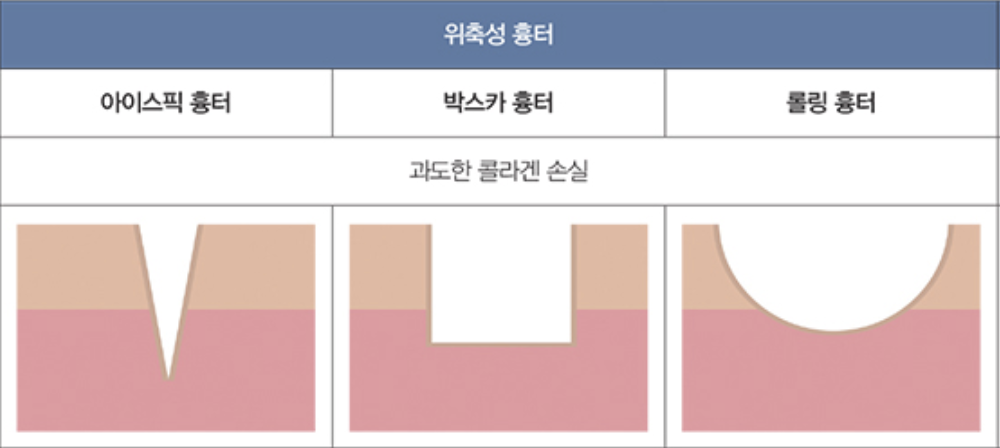
- Ice Pick Scars: Narrow, deep pits that look as if the skin was pierced with a sharp tool. These are common on the nose and cheeks and are known for being challenging to treat.
- Boxcar Scars: Scars with sharp, vertical edges, similar to chickenpox scars. The key here is smoothing out the distinct borders.
- Rolling Scars: These appear as broad, wavy depressions caused by fibrous bands pulling the skin down from below. They often look uneven under overhead lighting and worsen as skin elasticity decreases.
2. Why Combination Therapy is the Gold Standard
Most patients don’t have just one type of scar; they usually have a mix. Therefore, a multidimensional approach that targets both the surface and the deeper layers is essential.
- Erbium Fractional Laser: Precisely refines sharp scar edges to create a smoother surface. This is highly effective for boxcar scars.
- RF (Radiofrequency) Microneedling: Delivers thermal energy directly into the dermis to stimulate collagen production from within.
- Subcision: A procedure that breaks the “fibrous bands” responsible for rolling scars. Releasing these adhesions allows the depressed skin to rise back up.
- Collagen Boosters: Injecting agents like Re2O or Juvelook accelerates the healing process and fills in volume. These act as a powerful support system for long-lasting results.
Dr. Hyun’s Pro-Tip: When treating deep, old scars, I find that performing subcision using a CO2 gas delivery system (like TriFill Pro) while simultaneously infusing collagen boosters is significantly more effective than traditional manual methods.
3. Treatment Summary at a Glance
| Treatment | Principle | Primary Benefit | Target |
| Erbium Fractional | Ablative Laser | Smoothing edges & texture | Surface |
| RF Microneedling | Thermal Energy | Dermal collagen regeneration | Deep Layer |
| Subcision | Adhesion Release | Restoring depressed skin | Adhesions |
| Collagen Booster | Bio-Stimulation | Accelerating volume & healing | Regeneration |
4. Pain and Downtime: What to Expect
Since scar treatment involves inducing new tissue growth, some level of stimulation is inevitable.
- Pain: We apply a potent numbing cream, making the procedure quite tolerable. You may feel a dull aching sensation during subcision or deep fractional treatments.
- Downtime: Depending on the intensity, you may experience redness or micro-scabbing for 3 to 7 days. With modern technology, we can adjust the intensity to fit your lifestyle without causing major disruptions.
5. Conclusion: Choosing the Right Plan
To achieve successful results, keep these two things in mind:
- Don’t miss the “Golden Time”: The skin’s regenerative power is strongest when the scars are relatively fresh.
- Customization is Key: You must consult with a specialist to determine the best combination of lasers and boosters based on your scar depth, skin thickness, and acceptable downtime.
💡 Frequently Asked Questions (FAQ)
Q. How long do the results last?
A. Unlike aging-related treatments, the new tissue formed through scar therapy is permanent. While the improvement lasts indefinitely, maintaining overall skin elasticity is recommended to keep the texture looking its best as you age.
Q. How many sessions are needed?
A. While results vary, I typically recommend 3 to 5 sessions at one-month intervals. You may notice texture improvements after just one session, but deep scars require repeated stimulation.
Q. Can I wash my face immediately after?
A. Generally, gentle cleansing is possible on the evening of the procedure or the following day. Applying recovery ointment and sunscreen is essential.
I hope this guide helps you on your journey to smoother skin. If you have more questions or would like a personalized consultation, feel free to visit us at TERRA Dermatology Clinic.
Thank you. This has been Dr. Dongju Hyun.