Hello, I am Dongju Hyun, M.D., the Medical Director and a Board-Certified Dermatologist at TERRA Dermatology Clinic.
When facial volume begins to fade and skin elasticity isn’t what it used to be, collagen injections are often the first solution that comes to mind. However, determining which among Sculptra, Radiesse, and Ellansé is the perfect fit for your specific concerns requires a professional, analytical perspective.
Today, I will go beyond simple ingredient lists to dissect the differences in viscoelasticity, injection techniques, and the truth behind nodule concerns from a clinical standpoint.
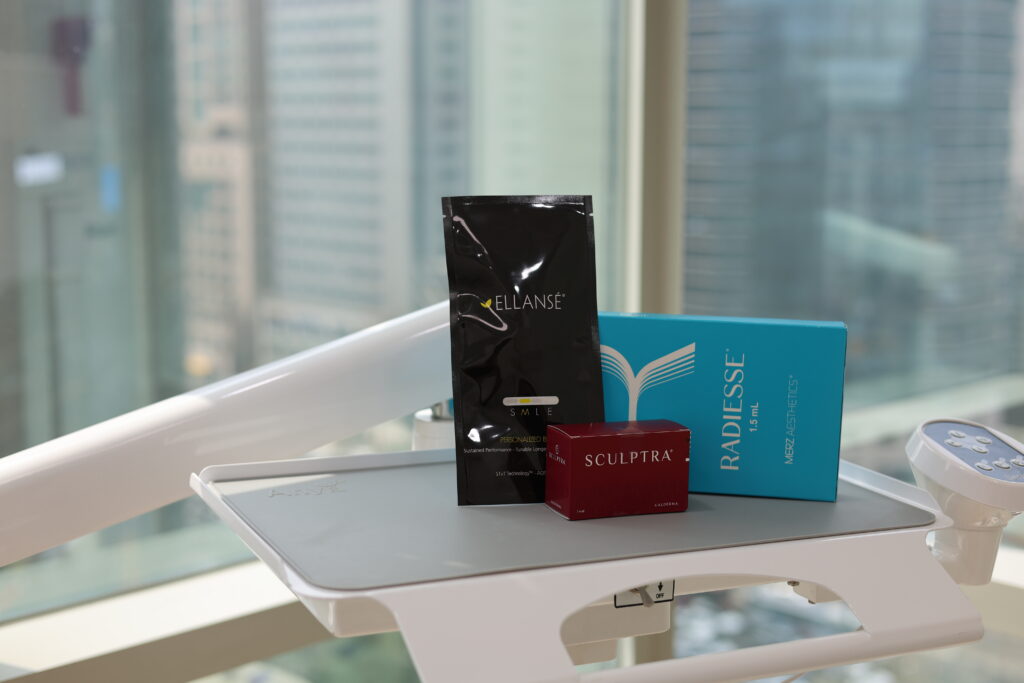
1. Differences in Injection Sites Determined by Ingredients and Viscoelasticity
While all three products induce collagen production, their rheological properties (physical characteristics) are entirely different. These differences dictate the injection sites and the application of MD Codes (anatomical injection guides).
① Radiesse & Ellansé: High Viscoelasticity (Structural Support)
Radiesse (CaHA) and Ellansé (PCL) possess high elasticity (G’). This means they have a strong ability to resist external pressure, making them excellent for building a structural “scaffold.”
- Injection Sites: Areas requiring structural support such as the cheekbones (Ck1, Ck3), jawline (Jw), and nose bridge.
- Application of MD Codes: Ideal for the Foundation phase of facial contouring. By injecting into deep layers (Deep fat or supra-periosteal), they provide a powerful lifting effect.
② Sculptra: Low Viscosity (Soft Volume)
Since Sculptra (PLLA) is injected after being hydrated (mixed with water), it has low viscosity and almost no elasticity. Rather than structural support, it specializes in spreading evenly over a wide area to improve skin density and create natural volume. Notably, its biostimulatory effect—the ability to induce collagen—is the strongest among the three.
- Injection Sites: Areas with soft tissue volume loss, such as the pre-auricular cheeks, mid-face, and temples.
- Injection Technique: Instead of structural anchoring, it is administered using a Fanning technique to “seed” the sub-dermal layers for gradual regeneration.
2. Myth vs. Reality: The Truth About Nodules
In the past, it was widely believed that Sculptra carried the highest risk of nodules (hard lumps). However, modern clinical data suggests otherwise.
Sculptra has become significantly safer
Nodule issues in the past were primarily due to insufficient hydration and high-concentration injections.
- Current Trends: The risk has been drastically reduced through protocols involving sufficient hydration (over 24 hours) with distilled water and High Dilution techniques.
- TERRA’s Know-how: We minimize the possibility of nodules by using mixing rollers to ensure particles are perfectly and uniformly dispersed immediately before the procedure.
Nodules to be more cautious of: PCL and CaHA
In reality, nodules resulting from Ellansé (PCL) and Radiesse (CaHA) are more challenging to manage due to their solid particle nature.
- Physical Properties: Sculptra nodules are often early inflammatory responses that can be relatively easily resolved with saline flushing or steroid injections.
- PCL/CaHA Nodules: Because these are clumps of solid particles, they are highly resistant to being dissolved by medication. If they persist, they often require physical removal (aspiration or incision).
3. Efficacy Timeline and Long-term Progress
| Product | Key Ingredient | Instant Volume | Longevity | Nodule Resolution Difficulty |
| Sculptra | PLLA | Minimal (Delayed) | 2+ Years | Relatively Easy (with early intervention) |
| Radiesse | CaHA | Present | 12–18 Months | Difficult (may require physical removal) |
| Ellansé | PCL | Present | 1~2+ Years | Very Difficult |
- Long-term Progress: Sculptra feels incredibly soft to the touch, as it is essentially your own tissue filling in over time. Ellansé and Radiesse have the advantage of maintaining their initial shape for a long time, but one must be careful about over-correction, as they are difficult to adjust once injected.
4. Which Collagen Booster is Right for You?
- “I want my whole face to look naturally plump.” → Sculptra is recommended. Usually performed in 3 sessions at 4–6 week intervals, it also improves skin texture.
- “I want to immediately lift deep nasolabial folds and a sagging jawline.” → Radiesse is recommended. Its high viscoelasticity creates a “scaffold” that resists gravity.
- “I want the instant effect of a filler with long-lasting results.” → Ellansé is recommended. You can enjoy instant gel volume and long-term PCL-induced collagen production simultaneously.
5. Conclusion: The Right Layer, the Right Amount
Unlike hyaluronic acid (HA) fillers, collagen-stimulating biostimulators do not have a “reversing agent” (dissolving injection). Therefore, the most reliable way to prevent nodules is the skill and experience of the physician.
A deep understanding of anatomical layers combined with precise design based on MD Codes is essential for beautiful, side-effect-free results. TERRA Dermatology Clinic adheres to the principles of thorough hydration and precision-dispersion injection to promise the safest collagen regeneration possible.
💡 Frequently Asked Questions (FAQ)
Q. Do I always need surgery if a nodule forms?
A. No. Especially with Sculptra, if caught early, a Flushing technique using saline and lidocaine can help disperse the clumped particles. However, for Ellansé or Radiesse, the key is injecting into the correct layer from the start, as they have a lower response to medication.
Q. Are all three procedures considered “fillers”?
A. In a broad sense, they belong to the “filler” category (things that fill), but medically they are called Biostimulators. This is because they work on the principle of making your own tissue grow rather than just filling space with a foreign substance.
Q. Which one produces the most collagen?
A. Sculptra. It has the strongest biostimulatory effect, leading to natural volume that builds over time. However, if you want immediate volume and structural retention, Radiesse is also an excellent choice.
This article was written based on the clinical experience of TERRA Dermatology Clinic. If you are curious about the best solution for your skin condition, please feel free to visit us.
This has been Dongju Hyun from TERRA Dermatology Clinic. Thank you.