Hello, this is Dr. Hyun Dong Ju of TERRA Dermatology Clinic.
In Ultherapy consultations, the most frequently asked question is “How many shots do I need?”. Naturally, the more shots, the better. But is it always better to have more shots? Not necessarily. You need to have the right amount of shots concentrated where needed. I explain this to patients by ‘Tug-of-war’It's explained this way. To win tug-of-war, team members can't stand sparsely and pull with individual strength. All personnel are tightly packed together, creating dense points of strength, and connecting those strengths without interruption.You can pull strongly.
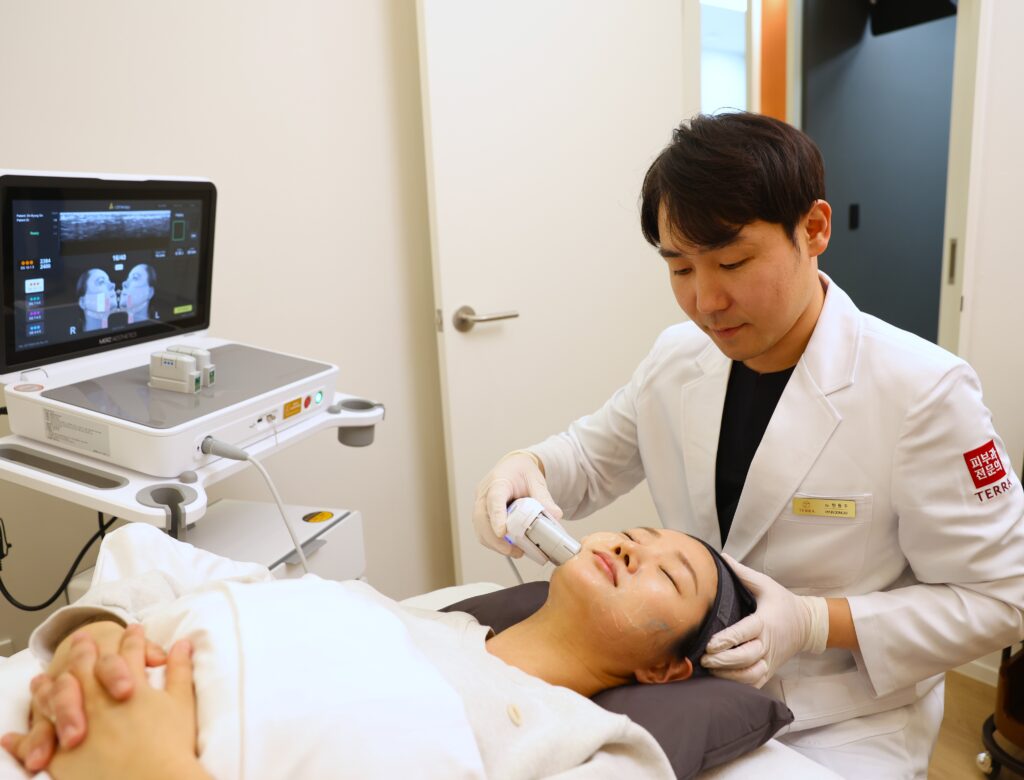
Today “A method for lifting by densely connecting Ulthera's thermal coagulation points in a linear (vector) and planar fashion.”Let's talk about it.
The essence of Ultherapy: A procedure that builds up ‘dots‘ (thermal coagulation points, TCP) rather than ’lines'.
Ultherapy High-Intensity Focused Ultrasound (HIFU)into the skin at a specific depth very small thermal coagulation point (TCP)and make it around Collagen denaturation → contraction → remodeling (neocollagenesis)This is a method that induces a “gentle heating” sensation, rather than a "broad heating" feeling. ‘create multiple hotspots It is close to the side. (However, in reality, it's not a point at a specific depth, but rather a column of heat generated from the skin surface to that point. For convenience, we will refer to it as the "heat spot" as claimed by the manufacturer.)
Here's the important point.
- hot spots Small narrow.
- The treatment results are hot spots In what ‘density‘ and 'directionality' are they arranged?is affected.
In other words, Ultherapy is not “lifting that forms a surface in one go,” but rather, Lifting created by the convergence of dots (lifting columns) It is a procedure.
2. Effective width of each shot: Why should it be dense
Hot spots (TCP) are “smaller” than you might think”
Some manufacturer-sponsored papers on Ultherapy mention that the hot spots created by Ultherapy are A freezing point smaller than 1mm³reporting as.
This coagulation point creates a ‘line‘ with a spacing of 1.1mm – 1.5mm depending on the head used. This is what we call an Ulthera "shot.".
This one shot is up to 25mm.
And the process of Ultherapy is to continuously stack these ‘lines‘ to create a "surface.".
Then the interval between shots should be about the same as the interval between dots, shouldn't it?
You need to “connect” them densely at regular intervals for clinically meaningful changes to occur.
3. Ideal spacing for each shot: “Standard 1.5mm”
Based on the user manual, the **TCP interval (Spacing)** for Ultherapy is 1–5mm rangeadjustable in, The standard is 1.5mmIt is presented as follows. (Depending on the tip used, it can be narrowed down to 1.1mm, but we will consider it as 1.5mm based on the most commonly used 4.5mm tip.)
Also, in clinical studies, Set the pulse interval within one exposure line to 1.5mm.The technology is repeated, designed to create a thermal solidification point along the line.
This interval,
- If it's too wideThe hot spots appear “broken” from each other. It's as if the members of a tug-of-war team are standing sparsely, so the strength is transmitted but leaks out in the middle.
- If it's too denseThere is a risk of over-treatment. The risk of side effects such as pain, swelling, and temporary abnormal sensation increases.
To summarize, here are the key techniques for Ultherapy:.
“Based on the standard spacing (1.5mm), create lines without breaks, and then create dense areas with standard spacing again.”
4. Dense + Sufficient Shots: “Density” is more important than numbers”
Now, let's move on to “sufficient number of shots.” I express the number of shots this way.
The number of shots is not a ‘fixed number'. “Density”is the value.
Although the total amount may vary depending on face size and degree of sagging, Same densityto be filled in for similar results.
So, how many shots?
Yes, precise numbers would be more impactful than vague terms like "rough density," wouldn't they?
So, let's do the calculation.
According to a dermatology research finding from Seoul National University, the average facial area of Korean women is 404.4 cm².
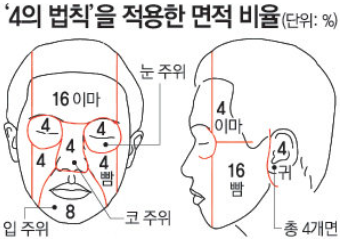
The area of the cheeks primarily treated with Ultherapy is 40%on each side. Including the submandibular area brings it to approximately 48%, and including a portion of the temple area brings the treatable range to about 50%.
Then, approximately 20,000 mm² will be the area to be treated.
The length of one Ultherapy shot is 25 mm, and it is administered at 1.5 mm intervals. What is the area covered by one shot?
25 mm × 1.5 mm = 37.5 mm²
Yes, that's right.
Then, finally, what is the total number of shots needed?
20,000 mm² / 37.5 mm² = 533.3
About 500-600 shotsYou can think of it as such.
Is there a basis for many hospitals recommending Ultherapy for 600 shots?
5. How to Win a Tug-of-War: Unbroken Force Point Connection (Vector Design)
Now, the main point of today's article is “Tug-of-war story”I will clinically reinterpret this.
- To win at tug of war
① Create dense support points (spacing)
② Power is transmitted (connected) without interruption
The pulling directions must converge into one (vectors).
In Ultherapy, these correspond to each other as follows.
- Fulcrum = Hot Spot (TCP)
- Uninterrupted connection = Dense grid completed with tight connections between lines
- Pulling direction (vector) = Procedure design (direction and distribution of lines)
The direction of pull here will vary from patient to patient, but it will mainly be the opposite of gravity, and in the lateral directions of the high point of the protruding fat.
Therefore, to achieve proper Ultherapy results
First, a delicate technique is needed to connect the lines closely.
Secondly, sophisticated design skills are required to determine at what depth the main hotspots will form for each patient and with which vectors these hotspots will be gathered to form the lifting surface.
6. Ultherapy at Theraph Plastic Surgery: 5 Details That Determine Results
Detail 1. Match the ‘layer' first: precisely where it's visible
One of Ultherapy's strengths is The ability to adjust the treatment depth while visualizing the tissue layers with ultrasoundis the value.
If the floors are different, the results will vary even with the same number of shots. “Where to shoot” comes before “just shoot a lot.”.
(Of course, real hot spots don't form as ‘points." Still, it makes sense to establish a primary depth where energy converges.)
Detail 2. Acknowledge the effective width of each shot: ‘Small, so packed tightly.’
The small hot spot is not a disadvantage, but an advantage. Because it allows for precise structural control.
Instead, the procedure must be equally sophisticated.
If you fire intermittently, it will be difficult for the effect to be produced as originally designed.
Detail 3. The interval defaults to “standard” and is adjusted according to skin condition.
The standard pitch (1.5mm) presented in the IFU is not just a simple number, Default that makes hot spots ‘connect'is the value.
However, there isn't one single correct answer for everyone. Consider pain, skin thickness, fat layer, nerve trajectory, etc. The balance of safety and efficiencyYou have to catch it.
Detail 4. Redefines “adequate shot count” to “density” instead of "total amount."
‘The number of shots is not important. What's important is whether enough density was achieved in the necessary areas.
Detail 5. Elaborate design, seamless connection of force points
Jawline, sagging cheeks, and double chin are ultimately Rearrange a structure that collapsed in the direction of gravity to be ‘upright' againIt's a task. If the line breaks in the middle, it feels like energy is being wasted, like a tug-of-war.
So, in procedure design, (1) Connectivity, (2) Directionality, (3) Layer Combinationis seen as the most important. This is in line with the fact that approaches with different vector directions are being discussed clinically.
Conclusion: Like a tug-of-war, “dense points of force + unbroken connection” make Ultherapy what it is.
To summarize today's story:.
- Ultherapy Small focal points (TCP)It is a procedure to create
- the design itself Standard spacing between hot spots is 1.5mmPremised on
- in clinical research Line spacing/densityappear as key factors for good results.
So, “doing Ultherapy properly” ultimately means
Understand the effective width of each shot → Connect them densely at ideal intervals → Design with a sufficient number of shots assuming ‘density' → Create a continuous fulcrum (vector).means.
Thank you for time.
This is Dr. Hyun Dong-ju from Lee Sang Therapy Dermatology.